Modeling the Sherman Tank in 1/72nd Scale
 

References

Below are listed the reference books I have utilized in the production of this website. Please note that these are not book reviews per se, because I am not an expert on the Sherman tank, so it is difficult for me to give educated reviews of the books. So instead I just give some technical details of each book, and general observations. If any site viewers wish to submit book reviews of their own, I will set up another page dedicated to true book reviews instead of just my reference list.

Because this table has become so large, I have been forced to split it into two pages.

You are currently viewing Page 1

Click here to go to Page 2


Table of Contents

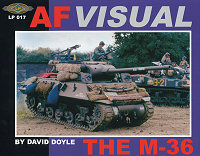
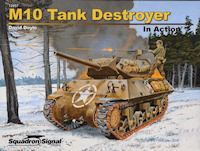
AFVisual - The M-36, by David Doyle
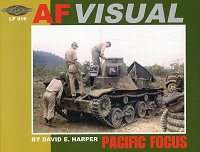
AFVisual - Pacific Focus, by David Harper
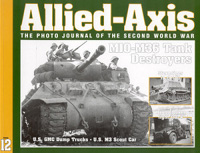
Allied-Axis Photo Journals, by Military Miniatures in Review
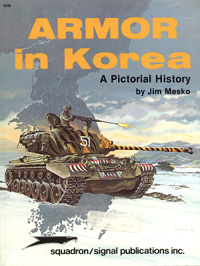
Armor in Korea, by J. Mesko
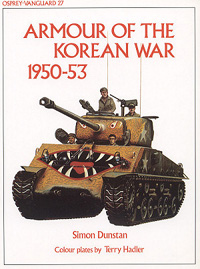
Armour of the Korean War 1950-53, by S. Dunstan
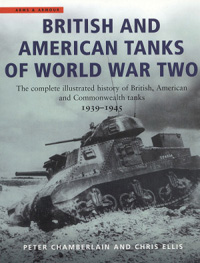
British and American Tanks of WW II, by P. Chamberlain & C. Ellis
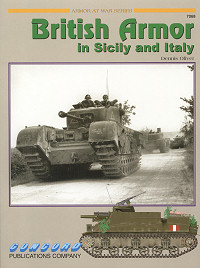
British Armor in Sicily and Italy, by D. Oliver
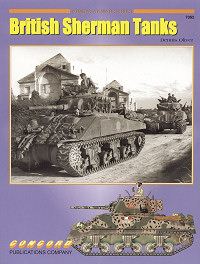
British Sherman Tanks, by D. Oliver
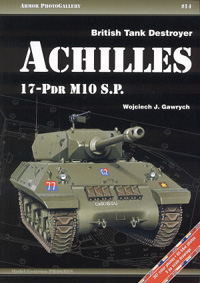
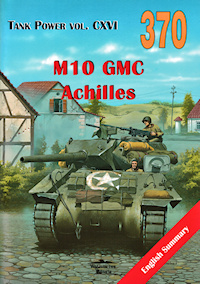
British Tank Destroyer Achilles, By W. Gawrych
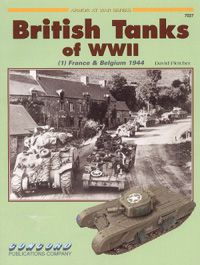
British Tanks of WW II (1) France & Belgium 1944, by D. Fletcher
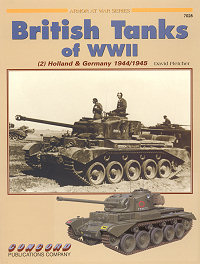
British Tanks of WW II (2) Holland & Germany 1944-45, by D. Fletcher
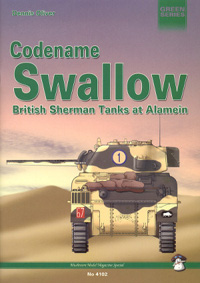
Codename Swallow, by D. Oliver
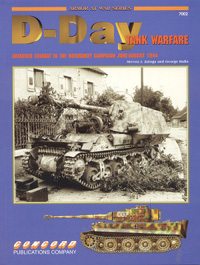
D-Day Tank Warfare, by S. Zaloga
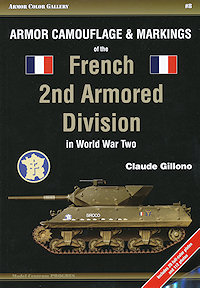
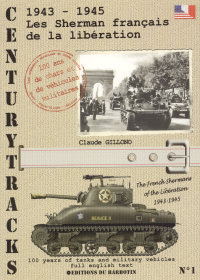
French Shermans of the Liberation, by C. Gillono
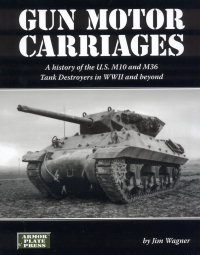
Gun Motor Carriages, by J. Wagner
Israeli M4 Sherman and Derivatives, by F. Verlinden
Israeli Sherman, by T. Gannon
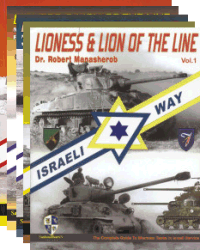
Lioness & Lion of the Line Vol.1, by R. Manasherob
M3 Grant M4 Sherman, by W. Gawrych
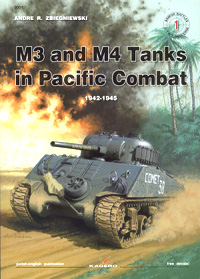
M3 and M4 Tanks in Pacific Combat, by A. Zbiegniewski
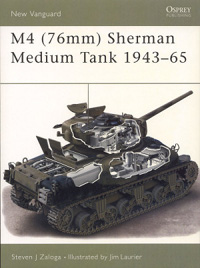
M4 (76mm) Sherman Medium Tank 1943-65, by S. Zaloga
M4 Sherman at War, by S. Zaloga
M4 Sherman at War, by M. Green & J. Brown
M4/M4A1 Sherman with Continental Engine, by Sawicki & Jackiewicz
M4A2 Sherman Part 2, by W. Gawrych
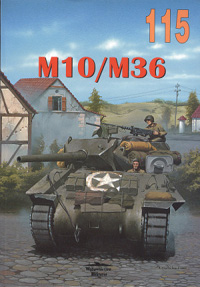
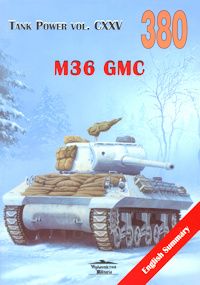
M10/M36, by W. Gawrych
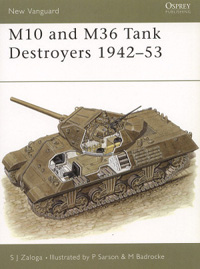
M10 and M36 Tank Destroyers 1942-53, by S. Zaloga

AFVisual David Doyle Letterman Publications 2004 51pp
The M-36
This series of photo-documentation books has been published for a few years now, but I've not seen one before this pair I recently purchased. They follow a very simple format: a page of background material followed by a collection of pertinent b&w photographs of the subject vehicle(s). This volume obviously covers the M36 series of tank destroyers, and does it fairly well. The photo captions are sparse, nowhere near as comprehensive as the captions in the Allied-Axis series. The photos are a mix of war-time in-action and production photos, some assembly drawings and views from the Army technical manual, and a handful of walk-around and interior photos from contemporary museum pieces. The text is adequate, though the author has misidentified several of the photos, confusing the M36 for the M36B2. But the brief background text in the front of the book does correctly differentiate between the two versions. No color is included, nor are scale plans. All in all, this is not a bad book, but it really doesn't offer much that can't be obtained from other sources that also contain additional material.
AFVisual David E. Harper Letterman Publications 2004 59pp
Pacific Focus
The second of two examples from this series that I recently obtained. This is the first of a pair of "Pacific Focus" volumes in this series from David Harper. There is no background text included in this book, and the photo captions are extremely brief, with only a sentence or two for each photo. At least one of the photos has a misidentified Sherman (M4 (105) mislabeled as an M4A3). The strength of this book is the large photo size, with only one printed per page, so they are very large and mostly clearly printed. Sherman photos comprise only a small section of the book, with the majority of the armor photos showing knocked-out Japanese tanks. There are also several photos of LVTs in action and knocked-out.
Allied-Axis Various Authors Military Miniatures in Review 2000- 96pp
The Photo Journal of the Second World War
This is a series of photo-documentation books, several of which have articles related to the Sherman or Sherman variants. Each volume contains several articles composed of many black & white photographs with extensive photo captions. These books have no drawings, no profiles, no color. Although these books aren't adequate to use as stand-alone reference works, they provide in-depth coverage of specific topics and are excellent at filling the gaps left by other books that provide only overview material.

Pertinent articles include:
Vol. 1: Sherman Flail
Vol. 4: M32B1 Sherman Recovery Vehicle
Vol. 4: Sherman Armored Recovery Vehicle (ARV) Mk I and Mk II
Vol. 8: Marine Corps Shermans of WW2
Vol. 10: U.S. Self-propelled Rockets
Vol. 12: M10-M36 tank Destroyers
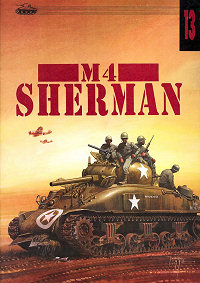
Vol. 13: Sherman: early and late
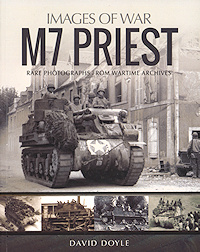
Vol. 17: M7 Priest

Armor in Korea J. Mesko Squadron/Signal 1984 80pp
A Pictorial History
Most modelers don't consider Korea to be a hotbed of modeling ideas for armor, due to its limited use there relative to armor use in World War II. So "The Forgotten War" remains forgotten amongst model builders as well. But this book provides loads of great modeling subjects, mostly UN, though with a bunch of vehicles from the Communists as well. The Sherman gets the most coverage, considering that it was the most commonly used tank in the war, though the M26, Centurion and other less common tanks are covered as well. A lot of well-researched background material is included, chronologically following the war's progression and the text is amply illustrated with many b&w photos. Several pages of color profiles are scattered throughout the book depicting tanks, armored cars, and other vehicles. If you can afford only one book on Korean armor, I would recommend this one, though I feel that all of the books described on this page compliment each other well and if you are serious about modeling this war, then you should try to find all of them.
Armour of the Korean War 1950-53 S. Dunstan Osprey Vanguard No. 27 1982 40pp
One of Osprey's older editions, this one has yet to be revised in the New Vanguard series. Regardless, it is a typically excellent Osprey volume and as the title suggests, it covers more than just the Sherman tank, though the Sherman does get the lion's share of coverage (along with the M26). As with all Osprey titles, this one gives a ton of background information with a great selection of numerous black and white photos and several pages of color artwork. One of the most colorful is shown on the cover, one of the tiger-faced painted Shermans from Operation Ripper. Who ever said that Shermans had to be drab?
British and American Tanks of WW II P. Chamberlain & C. Ellis Arms & Armor Press 1969 222pp
The complete illustrated history of British, American and Commonwealth tanks 1939-1945
A recent reprint of a classic encyclopedia from the 1960s. As the title indicates, this book isn't about only the Sherman tank, but rather is a catalogue of all British and American tanks developed or used in World War II. The developmental history of each vehicle is surprisingly comprehensive and this book provides an excellent overview of the progression of Sherman development from the earliest prototypes to the final versions. The book is laid out as an encyclopedia with very terse and brief entries for each vehicle, though the amount of information provided for each vehicle is really impressive. Most vehicles are illustrated by a photo with important versions covered by more than one. There are no drawings or detail photographs and no color. All variants of the Sherman are included including prototypes, experimental and support vehicles too. Background information includes operational dates, dates and location of manufacture, technical specifications and numbers produced.
British Armor in Sicily and Italy D. Oliver Concord 2007 72pp
Another one of Dennis Oliver's books on British armor, this time covering its use and operation in Sicily and Italy. Unlike other Concord "campaign-type" books, this one doesn't chronologically cover the armored operations of this theater, but rather looks at each British armored unit individually, giving a very brief historical account for each unit with mention of the specific types of armored vehicles used by the unit. The numerous black and white photos are well-chosen to illustrate the variety of vehicles, units, colors and markings seen in this theater. Dennis' gorgeous color profiles decorate the center pages of the book, showing the colors and markings of a variety of vehicle types, though the photographs tend to lean towards Shermans and its variants, likely due to their prevalence in the British Army. I can see a great many diorama ideas being inspired by this book.
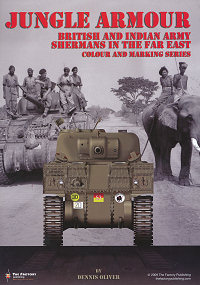
British Sherman Tanks D. Oliver Concord 2006 72pp
I've wanted this book ever since publication, and I finally found a shop that had it in stock. Some of the information from Oliver's Codename Swallow (q.v.) is repeated in this volume, but in no way does this book cover Alamein Shermans in as much detail as his other book. The background text in the beginning of the book doesn't cover chronological operations of the Sherman throughout the war, but rather has information on each specific Sherman variant that the British used, telling how many were in service, changes made to them, and how they were generally used in operation. The photo coverage is chronological, beginning in North Africa, and also covering the Middle East, Sicily, Italy and northwest Europe. Personally I am amazed at how late in the war the early version Shermans with direct vision slots were used. Several pages of Oliver's wonderful color profiles and four-view paintings are included, showing many quite interesting color schemes, such as the one shown on the cover. Again, a highly recommended book.
British Tank Destroyer Achilles W. Gawrych Model Centrum Progres 2006 72pp
17-pdr M10 S.P.
One of the Armor PhotoGallery series, this is a superb photo guide to the British 17pdr M10 Tank Destroyer. Typical of the format for this series, the first 2/3 of the book is a collection of full color walk-around photos of the Achilles completely illustrating every detail of this vehicle, inside and out. Several pages of scale plans are then provided and the book ends with a brief, though comprehesive development and operational history of the Achilles, with several wartime photos giving diorama builders numerous ideas. This could easily be the only Achilles reference one would need, though it never hurts to have additional background information.
British Tanks of WW II (1) D. Fletcher Concord 2000 72pp
France & Belgium 1944
Typical Concord format: several pages of background text, followed by page after page of black & white photos showing British tanks in a large variety of combat and non-combat situations. This is not a book that focuses on the details of particular vehicles, but rather on the operational use of British tanks and the photos reflect this intent. The color artwork in the center of the book is outstanding and instead of being a collection of side view profiles, the artist has taken some liberty with perspective and given us some more 3-dimensional views of the tanks. I must admit that it doesn't work very well in all cases, though generally they are very well done. Coverage of the Sherman is only a part of this book and other British light, medium and heavy tanks are covered in detail as well.
British Tanks of WW II (2) D. Fletcher Concord 2001 72pp
Holland & Germany 1944-1945
As a follow-up to his previous title, David Fletcher gives us another 72 pages of photos and text describing the use and operations of British armor in the later stages of WW II. The few pages of introductory text at the beginning of the book do an excellent job at describing the major armored actions in the final year of the war. Much of this information is new to me, not being very well-versed in British armor. As with the other Concord books, the bulk of this book is taken up with numerous black & white photos of British tanks in a variety of combat and non-combat roles. As indicated by the cover, the British heavies get a lot of coverage here, with the Challenger, Comet and Cromwell seemingly out-numbering the Sherman tank in their photo coverage. That's actually a good thing, considering the other books available that address the British Shermans, and this book is a needed resource for fans of the heavy tanks. Shermans to get a fair shake however, and many interesting photos and color profiles are included herein.
Codename Swallow D. Oliver Stratus 2006 36pp
British Sherman Tanks at Alamein
This book doesn't really tell you everything you would want to know about Shermans in and around El Alamein, but rather it covers only the colors and markings of the Sherman tanks at that place and time. Oliver does an outstanding job at clarifying the dizzying method the British used to mark their tanks. Even though I feel it was the most ridiculously complicated system the human mind could devise, at least now I undertand it. The colors of the tanks are fully described and illustrated in absolutely gorgeous color profiles and diagrams. Photos are very few, which is a blessing, since the ones that are included are rubbish. During the publication process, the computer scans of the photos were compressed to such a degree that they were distorted beyond use. To be honest, this book should never have been printed with photos like this, and it's a testament to how narrow of a niche our hobby is that they actually proceeded with publication. But back to the positives: excellent scale drawings are included of the Sherman II and Sherman III, although very little information is included to describe physical details of these tanks. A must-have book for fans of British Shermans.
D-Day Tank Warfare S. Zaloga Concord 1994 72pp
Armored Combat in the Normandy Campaign June-August 1944
One of Concord's earlier books by Zaloga, this one covers both Allied and Axis tanks during and after the D-Day invasion in 1944. The standard format for these Concord books is a couple pages of background text that sets the stage for the photographs that follow. Zaloga describes in detail the armored operations of the time period, outlining the major battles and use of armor by both sides. The dozens of b&w photos and several pages of color profiles also cover both sides equally, with the Sherman tank providing only a portion of the images. Many never-before-seen photos and impressive artwork are included. Not a great reference for learning the detailed differences between Sherman variants, but rather the emphasis is on the operational use of the tanks with photos mostly of in-action vehicles and wrecks.
French Shermans of the Liberation C. Gillono Editions du Barbotin 2006 62pp
CenturyTracks No. 1
This is another one of those books that has long been on my want list, but I've only recently been in a position to buy it. First in the new series of books called CenturyTracks, this book is all-inclusive, and if it's typical of the series, I wouldn't hesitate to buy any of the others. It's amazing how much information can be packed into such a small book. First, there is a complete summary of the development of the Sherman tank, with extensive descriptions and drawings showing differences between the numerous versions. This is followed by descriptions of the armored units in the Free French Army, which goes into great detail of which versions of Sherman were allocated to different units (as well as exceptions to the rules). The book ends with 12 pages of color paintings showing several profiles of example vehicles and the most extensive description of unit markings I have seen for any nationality. I think this book literally has everything you need to know about French use of the Sherman tank (except perhaps combat stories). The book is bilingual with an excellent English translation of the complete text.
Gun Motor Carriages J. Wagner Armor Plate Press 2008 224pp
A History of the US M10 and M36 Tank Destroyers in WWII and Beyond
This is a book that I very anxiously awaited, but am a little bit disappointed with. It's not that it's a bad book, but I see here some unrealized potential combined with some false expectations on my part. I was led to believe that this was primarily a modeler's book with enough information to satisfy military historians and tank buffs alike. In fact, the opposite is mostly true, in that this is primarily a history book, with only a small amount of material that will appeal to modelers (unless of course, they're history buffs). There are chapters on the development of the tank destroyer concept, the search for weapons and design of vehicles, and operational use of the TDs in most of the major campaigns of the war. Each chapter is ended with several pages of very large and clearly printed B&W photos. There are only a couple dozen walk-around type photos of museum pieces that modelers will find helpful in their projects, but this book in no way is a complete resource for modeling the M10 and M36. No color or useable drawings are included. One entire chapter is wasted showing museum photos of "Friends & Enemies", i.e., tanks and vehicles of other nations. There is a table of TD Battalions that saw combat with dates and lists of vehicles used by each unit, but no other information, such as where they were in action, important campaigns or battle results. This book could have been so much more....
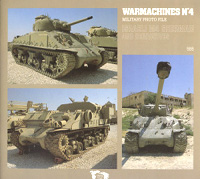
Israeli M4 Sherman and Derivatives F. Verlinden Verlinden 1990 36pp
Warmachines No. 4 Military Photo File
The Verlinden Warmachines books are collections of high quality color photographs of museum vehicles from around the world. In this case, the photos are of Shermans and their derivatives preserved in the Latrun Tank Museum in Israel. These are walk-around style photos showing the exterior detail of several tanks. The photos are sharp, clear and large enough to show what they intend. This book is an excellent supplement to the following title from Gannon, as it includes a lot of detail that Gannon's book lacks. However, it really is inadequate as a stand-alone reference, as it provides very little vehicle information and in fact, some of the photo captions are incorrect in identifying the version of tank being pictured. Despite these limitations, this is a necessary book for those who wish to model Israeli Shermans.
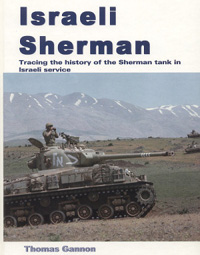
Israeli Sherman T. Gannon Darlington Productions 2001 240pp
One of the Sherman "bibles", this is the book for accurate and well-researched information on all versions of Israeli Shermans, including support vehicles and other conversions. The author has spent a great deal of time photographing many tanks both in Israel and around the world, and also has scoured official Israeli photo archives in order to answer many common questions that modelers have had for years regarding Israeli Shermans. Several myths have been laid to rest and new questions raised. Everything is covered in this book, from the very first Shermans used during the Israeli War for Independence, to the final Shermans used even into the 21st Century. Proper nomenclature of the many Sherman versions is covered as are the Shermans that were sold to Chile and afterwards modified with new armament. Also included is the dizzying array of Sherman variants that the Israelis produced, including one I think that was used to make ice cream. All photos are black & white (except a couple on the front and back covers).
Lioness & Lion of the Line Dr. R. Manasherob SabIngaMartin Publications 2007 80pp
Volume 1
Following on the Israeli theme, we have this new book independently published by Dr. Robert Manasherob, an officer in the IDF (Res) and an avid modeler. It's a fairly pricey book, but once you see the extremely high quality of its production, you'll know why. Printed on heavy gloss stock, with large, sharp, color and b&w photos, and some of the nicest color profiles I've ever seen, this is really a top-of-the-line book. The text reads almost as a novel, following the early years of Israeli armor development, and its race to procure up-gunned Sherman tanks. Amply illustrated with b&w period photos, many never before published, it follows the M50 program from conception to around 1958. Color and b&w walk-around photos cover the wheels and running gear in exceptional detail, as well as complete interior coverage and some external hull details. Line drawings are included for several variants of the M50, but no scale is mentioned (I assume 1/35th). Six gorgeous color profiles are included, as is extensive color information on the markings of the early M50s. Volume 1 covers only the M50 program, with just a teaser for the M51. Volume 2 will include the M51 and include more of the M50 external walk-around photo coverage as well. Volume 3 will cover early Sherman use by the IDF.
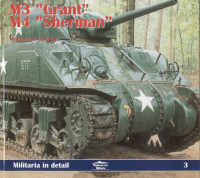
M3 Grant M4 Sherman W. Gawrych Wydawnictwo Militaria 2000 50pp
This is basically a "completer" book. It doesn't contain enough information to be a stand-alone reference for the Sherman, but rather it contains much that other books lack. It is primarily a collection of full-color walk-around photographs showing numerous details of several M3 and M4 tanks in various museums around the world. The photo coverage is only an overview of the vehicles, but it does a good job of covering all of the major details. The book is rounded out with several pages of excellent side-view line drawings of all the major versions of the Sherman tank, plus several scale drawings of the M4 suspension, both VVSS and HVSS. Finally, there are a handful of very nicely done color profiles on the front and back covers. Very little background information is included and text is limited to brief photo captions. The M4 is covered in much greater detail than the M3 and I think these two subjects should have been separated into two volumes.
M3 and M4 Tanks in Pacific Combat A. Zbiegniewski Kagero 2004 78pp
1942-1945
The M3 in this title is referring to the M3 Light Tank (Stuart), not the M3 Medium Tank (Lee/Grant). This is actually quite a small book, but loaded with great stories. It describes the battles for several Pacific islands and briefly touches on the roles played in those battles by the M3 and M4 tanks of the Australian Army, the US Army, and the US Marine Corps. The book lacks detailed coverage of the tanks involved. Photographs are typically in-action photos, not detailed close-ups, and in fact, many of them don't even picture tanks at all. Also lacking are maps. It is assumed that the reader is already familiar with the Pacific Theater. Interestingly enough, Japanese tanks are mentioned a little bit as well with several photos of knocked out tanks, and a couple are included in the very well-done color profiles along with the American tanks. One special bonus to this book is the inclusion of a small sheet of decals that provides markings for several American and Japanese tanks.
M4 (76mm) Sherman Medium Tank 1943-65 S. Zaloga Osprey 2003 48pp
This is the second of two Osprey New Vanguard volumes on the Sherman gun tank, covering the late, 76-mm armed versions of the tank. The typical Osprey format is to follow the development of the vehicle chronologically, from the earliest prototypes to the final versions that saw action on all fronts of the war. This book discusses the use of the Sherman in the US military, as well as lend-lease vehicles to the USSR and Commonwealth countries. The typical Osprey format is lots of superb text, well-illustrated with numerous black & white photos of prototypes and vehicles in service. There are several very nice line drawings of the many versions of the late Sherman, though they are small and not printed to scale. Several pages of color artwork fill out the volume. Post-war coverage includes limited discussion of tanks sold to foreign countries after the war, plus Sherman use in Korea and the Middle East.
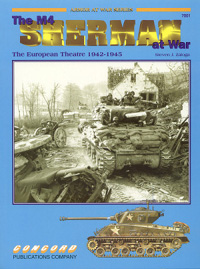
M4 Sherman at War S. Zaloga Concord 1994 72pp
The European Theater 1942-1945
The first Concord book by Zaloga that's devoted completely to the Sherman tank. Coverage begins in the Mediteranean theater, and covers North Africa, Italy and northwest Europe. The standard format for these Concord books is a couple pages of background text that sets the stage for the photographs that follow. Zaloga describes in detail the armored operations of the time period, outlining the major battles and use of the Sherman tank in these battles. The dozens of b&w photos and several pages of color profiles also cover all of the major variants of the Sherman, plus many of the less common versions as well. Many never-before-seen photos and impressive artwork are included. It's not a great reference book for learning the detailed differences between Sherman variants, but rather the emphasis is on the operational use of the tanks with photos mostly of in-action vehicles.
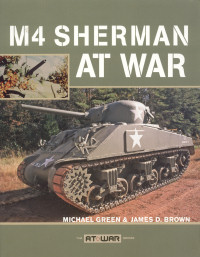
M4 Sherman at War M. Green & J.D. Brown Zenith Press 2007 128pp
I admit that when I first saw this book advertised, I had assumed it was just a coffee-table type of book, you know: written for a very general and non-technical audience. After being encouraged to check it out, I did so, and I'm glad to have bought it. I don't know if the authors did any primary research for this book, or if it's just an excellent compilation of other studies, but it is a very comprehensive book on the development of the Sherman from the T-5 through the Sherman's use in Korea. It is illustrated with a broad selection of period b&w photos (and some color), drawings and photos from the tech manuals, and color photos of Shermans existing in museum and personal collections today. Good coverage of the interior is one of the book's highlights. What this book lacks is the type of specialty items that modelers crave: such as scale plans and profiles showing colors and markings of specific vehicles. Other than that deficiency, this book is a valuable addition to my collection.
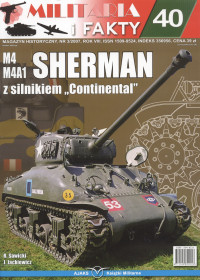
M4/M4A1 Sherman R. Sawicki & J. Jackiewicz Ajaks 2006 78pp
with the Continental Engine
This book is a special release of the Polish Militaria i Fakty magazine, compiling several articles related to the M4 and M4A1 Shermans. There are 15 pages of text (only in Polish - no English translation) describing the development of these tanks and their variants, such as the Grizzly. Many b&w photos are interspersed throughout this section (again with captions only in Polish), many of which I've not seen before, and some from the Army technical manuals. The meat of the book is 44 pages of awesome scale drawings, showing just about every type of M4 and M4A1 in top, side and oblique views. These drawings are captioned in English. Drawings are also included of tracks, wheels and ammunition. Not all track and wheel types are included, but perhaps these are the only ones seen on M4/M4A1s. Nine pages of color and b&w walk-around photos follow the drawings and the book is rounded out with seven pages of beautiful color profiles (including the covers). I would recommend this book even for those who don't read Polish, as long as you have other books describing the tank development history.
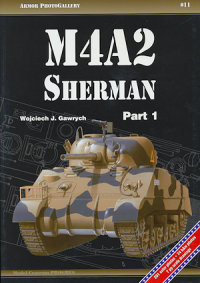
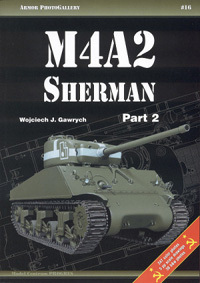
M4A2 Sherman Part 2 W. Gawrych Model Centrum Progress 2007 72pp
Second part of this Armor Photo Gallery series, this volume covers the 76mm-armed M4A2. Part 1 (which I am desparately trying to find) covers the 75mm-armed M4A2. Again, typical of the format for this series, the first 2/3 of the book is a collection of full color walk-around photos of the M4A2 (76)W HVSS completely illustrating every detail of this vehicle, inside and out, including the engine. Several pages of scale plans are provided, as well as detail drawings from the original technical manual. The book ends with a development and operational history of the tank and many wartime photos giving diorama builders numerous ideas. Since this tank served in large numbers as a lend-lease vehicle to the USSR, most of the photos depict Soviet M4A2s fighting on the eastern front.
M10/M36 W. Gawrych Wydnawnictwo Militaria 2000 58pp
I am learning to speak and read Polish, but not fast enough. Number 115 in this popular series of armor reference manuals is this volume covering the tank destroyers based on the Sherman chassis. All text in this book is in Polish, except for the photo captions, which are repeated in English. Based on the abundant photos, the book obviously covers these vehicles from their initial design and development through their operational use. The photos are a mix of government shots of the early trials, and in-action scenes. Not much in the way of detailed walk-around photos, though some of the pictures give glimpses of the vehicle interior and some external details. The real plus to this book is the wonderful scale drawings of all versions of these two TDs, plus several pages of color profiles.
M10 and M36 Tank Destroyers 1942-53 S. Zaloga Osprey 2002 48pp
In the standard format for the Osprey New Vanguard series, Steve Zaloga gives us a complete developmental background of the Sherman-based tank destroyers. Lots of superb text, well-illustrated with numerous black & white photos of prototypes and vehicles in service. There are several very nice line drawings of the several versions of these TDs, though typical of this publisher, they are small and not printed to exact scale. Several pages of color profiles are included showing a mix of the earliest versions to see combat, as well as vehicles still in use through Korea. Even though the title says coverage is only through 1953, there is some small discussion of usage of these vehicles into the late 20th Century.

References Page 2

Back to Table of Contents

Modeling the Sherman Tank in 1/72nd Scale